Today Jomboy posted on Twitter four photos of high school baseball fields that have some of the more wacky dimensions you will ever see. What followed was a long thread of many people putting in their bid for weirdest dimensions for a baseball field and I have to say I am mystified at some of them. Everything you think a baseball field would look like is completely turned on its head when you look at some of these fields. Take a look at one of the photos he tweeted, the field belongs to Redwood High School in Larkspur, California. The person who posted the photo thankfully told us the dimensions of the field and this is how it stands, 290 right, 290 to left and 280 to center, with a 20 foot high immovable fence in the center field arch. The part of the field that should be the longest is 10 feet shorter than left and right….what?
To give you a little insight, most baseball fields have these dimensions, a minimum of 325 ft down the lines from left and right, and about 400 ft to dead center field. Now every ballpark in the world is going to have varying dimensions. Let us say that right field is a little shorter than 325 ft, think Yankee Stadium’s short porch that’s 314 ft down the line. A stadium may make up for the short porch by extending center field or right center in Yankee Stadium’s case. Obviously the field will play better for lefty hitters, which is why when the Yankees design their lineup they want to have a healthy dose of lefties to utilize that porch. Everything varies from park to park, because each one has its own unique build. In Fenway Park, they have the Green Monster, which is 310 ft, but in order to combat hitters from simply hitting a pop up to left, they have to hit it over its 37 ft fence.
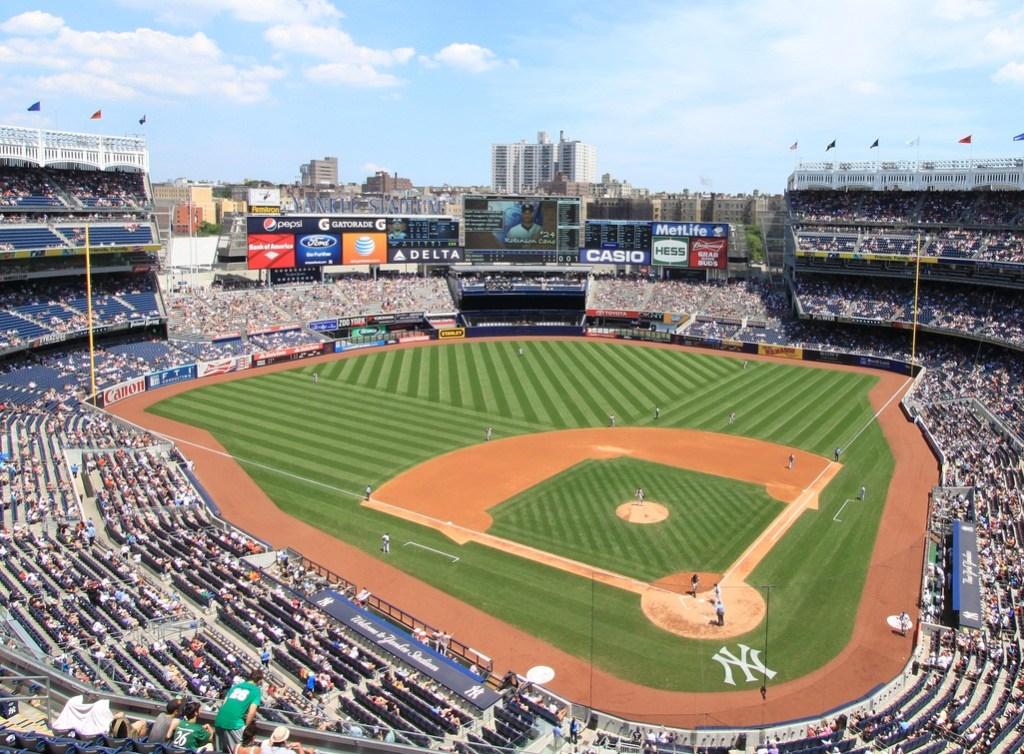
With that being said no MLB stadium today has the wacky dimensions that some of these high school fields have. One of my favorites from these threads is the field Jared Carrabis tweeted, with his dimensions coming in at 310 ft to right, 570 ft to left and about a 1000 ft to center. No really, go look at the picture of the field. It makes me never want to play outfield ever in my life. If a ball get past you, you might as well just wave to it. One of the main reason why I think some of the fields are built this way is the fact they were built in large cities, with minimal amounts of room to make a normal field. So instead of building a normal field in a different location, a high school will build a field right next to their school and just make the dimensions whatever they wanted to fit. I don’t believe as you can see, there is a certain regulation of sized field you have to play on in high school.
What I really love about this little thread is the fact that I played on many of these fields playing high school baseball in New York City. As you know there’s not a lot of room in the boroughs to build perfect dimensioned fields. One of these fields included my own high school Archbishop Molloy. Thomas Hackimer, current minor league prospect for the Minnesota Twins, who I played with in high school, was kind enough to throw a picture of our field in the running. The dimensions of our field was 250 to left field (40 foot high fence), and about 500 feet to dead center. Oh and the whole field is surrounded by a track that was in play. I couldn’t tell you how many times I fell trying to go from grass over a metal railing onto the track attempting to catch a fly ball. And I can’t tell you how many times I pimped a single thinking the ball would go out over that 250 foot fence. But I have to admit it was one of the nicer fields I got to play on in high school despite these factors. The way the tall apartment buildings hung in the background of left field and how the school sat past the right field wall. I wouldn’t have traded it for anything in the world.
Funny story, my high school coach, the legendary Jack Curran, would discourage people from hitting home runs over the left field wall during bp. He would make you stop hitting and go get the ball you hit in the middle of bp, and good luck trying to bring the ball back. There were many fields I played on in the city that would make a lot of people scratch their heads and ask, why would someone build this like this? I even played at a public park with an all sand infield with no fences. If you hit a ball past the outfielder it was rolling to the other side of the park to the people playing softball on the other fields. Not your ideal conditions but it’s what he had to go through. To me it adds character, trying to block a ball with your body like your life depended on it as the ball hit a divot in the outfield was such an adrenaline rush.
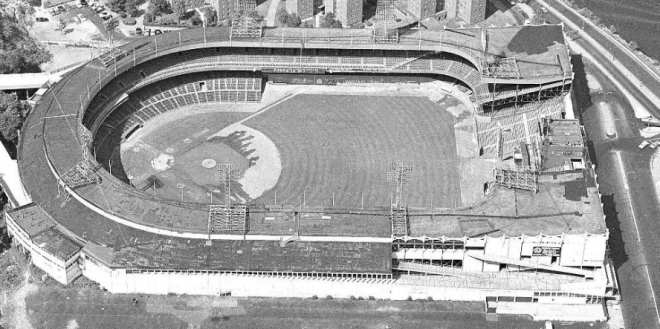
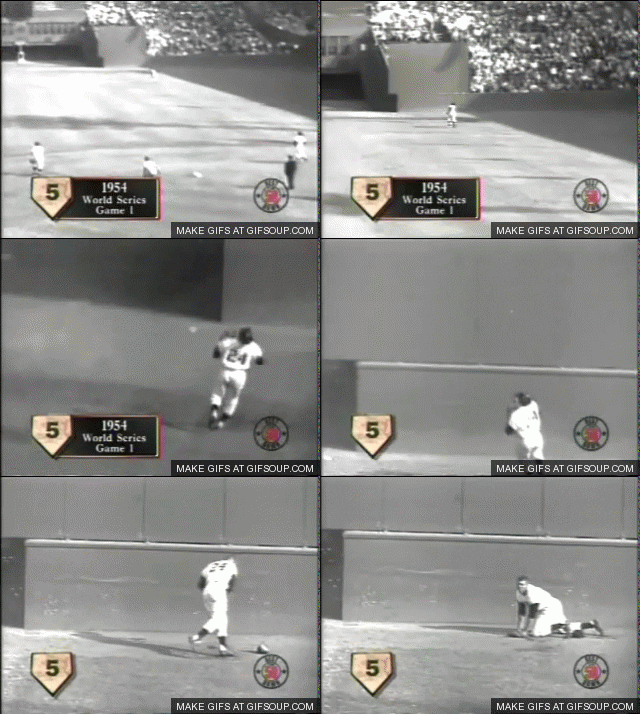
One of the funniest parts about this thread is the fact that older MLB stadiums used to have these same outrageous dimensions. One of the most famous stadiums for this was the Polo Grounds, where the New York Giants played from 1891 to 1957. The dimensions were 279 ft to left, 450 ft to left center, 483 ft to center, 449 ft to right center, and 258 ft to right. The field looked more like a football field than anything, but the stadium is famous because of some famous plays that happened there. It is the home of Willie Mays’ famous over the shoulder catch in right during the 1954 World Series and Bobby Thompson’s “Shot Heard Round The World,” that led to the Giants winning the pennant in 1951. Thankfully MLB stadiums today would never allow for these types of dimensions, but it is extremely fascinating to think that back in the day players would be playing on the same types of dimensions I did in high school. You had to be an absolute monster to put some shots out on those fields, but I’d give up anything if we could be back on those fields playing again. Until then, we miss you sports. Stay safe everyone.
 The Washed Up Athlete